One year, almost 100 million records, AI transcription and smarter research tools
GeneaGenie
Hello
This month is very special to us: GeneaGenie launched exactly one year ago. What began as an automatic GEDCOM search across 40 million indexed records has grown into a much broader genealogy workspace with almost 100 million records.
In that first year, we built and added far more than we would have dared to imagine at launch. This month we are continuing that journey with AI transcription, more flexible archive searches and smarter research guidance. And we are far from finished.
We are also adding 2,441,677 records from six Belgian and Dutch archives. Thank you for searching, testing and helping GeneaGenie grow during its first year.

One year of GeneaGenie

Looking back at everything that has changed in twelve months makes us genuinely proud. We started with one idea: make the scattered clues in archives, collections, genealogical organizations and volunteer projects easier to find. Today, GeneaGenie not only searches almost 100 million records, but also helps you share your own documents with the world (and earn credits for contributing them), explore your tree, spot what is still missing, start a search from the person you are researching, read original documents and decide where your research should go next.
We built a great deal in one year, learned just as much, and are still only getting started. We are especially grateful to the many volunteers who have spent years collecting historical sources and making them accessible. Every search, suggestion and piece of feedback has also helped shape GeneaGenie into what it is today. Thank you for being part of its first year.
Over the past year, we have also connected with many archives, genealogical societies and other initiatives to share their data responsibly and securely, and to make it easier to discover through smarter search. We thank them for placing their trust in GeneaGenie. And this is only the beginning: more collaborations will follow. Do you know an organization or initiative that would like to join us? Please get in touch.

One search for every life event

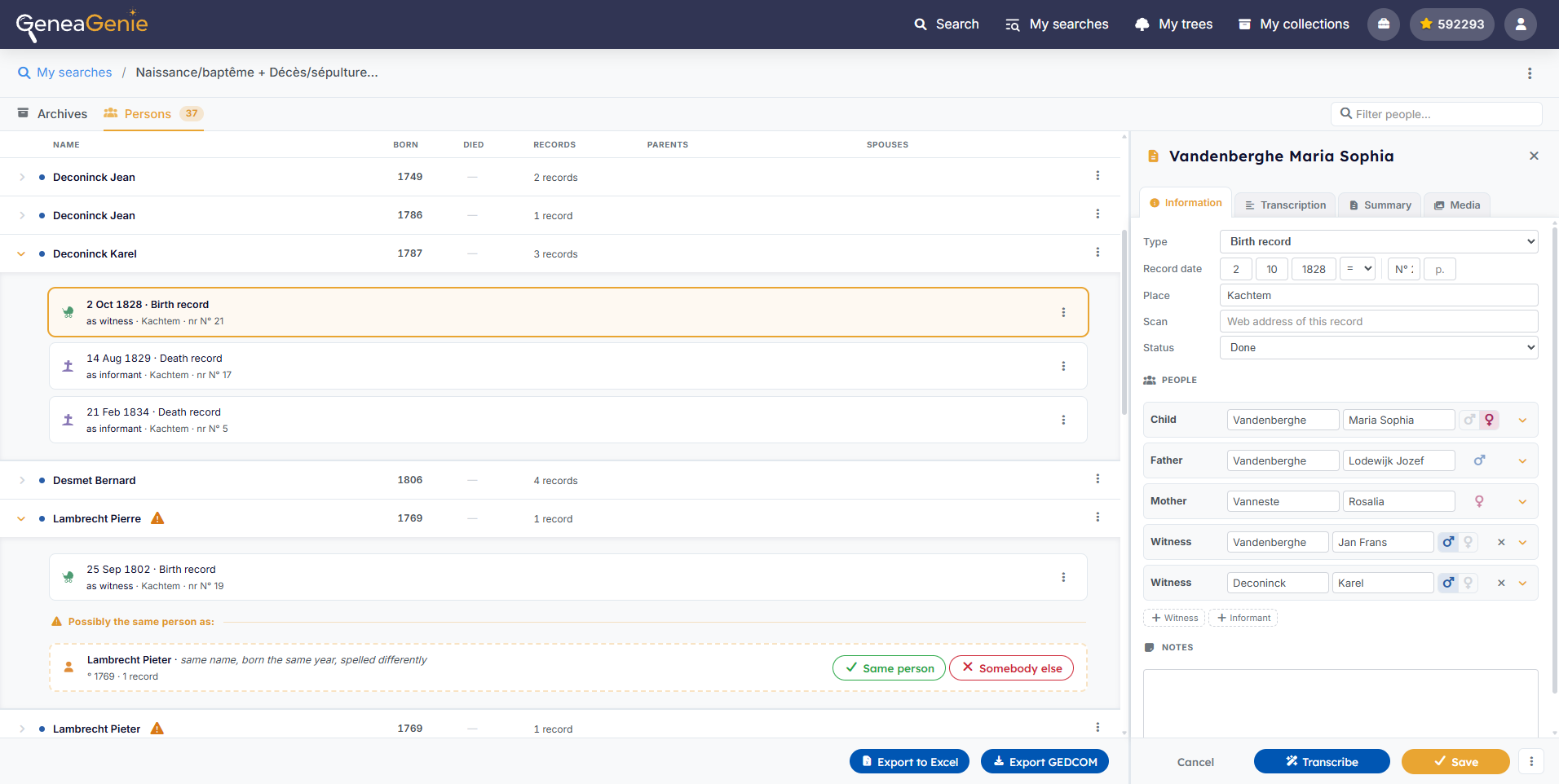
A single search through the scans can now include births, marriages and deaths at the same time. You no longer need separate searches to follow the same family through different stages of life.
When you add records, GeneaGenie automatically merges them when the evidence clearly points to the same person. If there is any doubt, they remain separate and you get a clear comparison screen. You can then review the details and merge the people yourself.
This is the most reliable way to research your family history: start with the original scan, read the record, capture its information and build your family tree step by step from those sources. That way, every family connection rests on evidence. It is much safer than copying details from other family trees, where mistakes can easily be repeated and spread further.
Bringing births, marriages and deaths together and comparing people within a single archive search.

Transcribe a record with AI

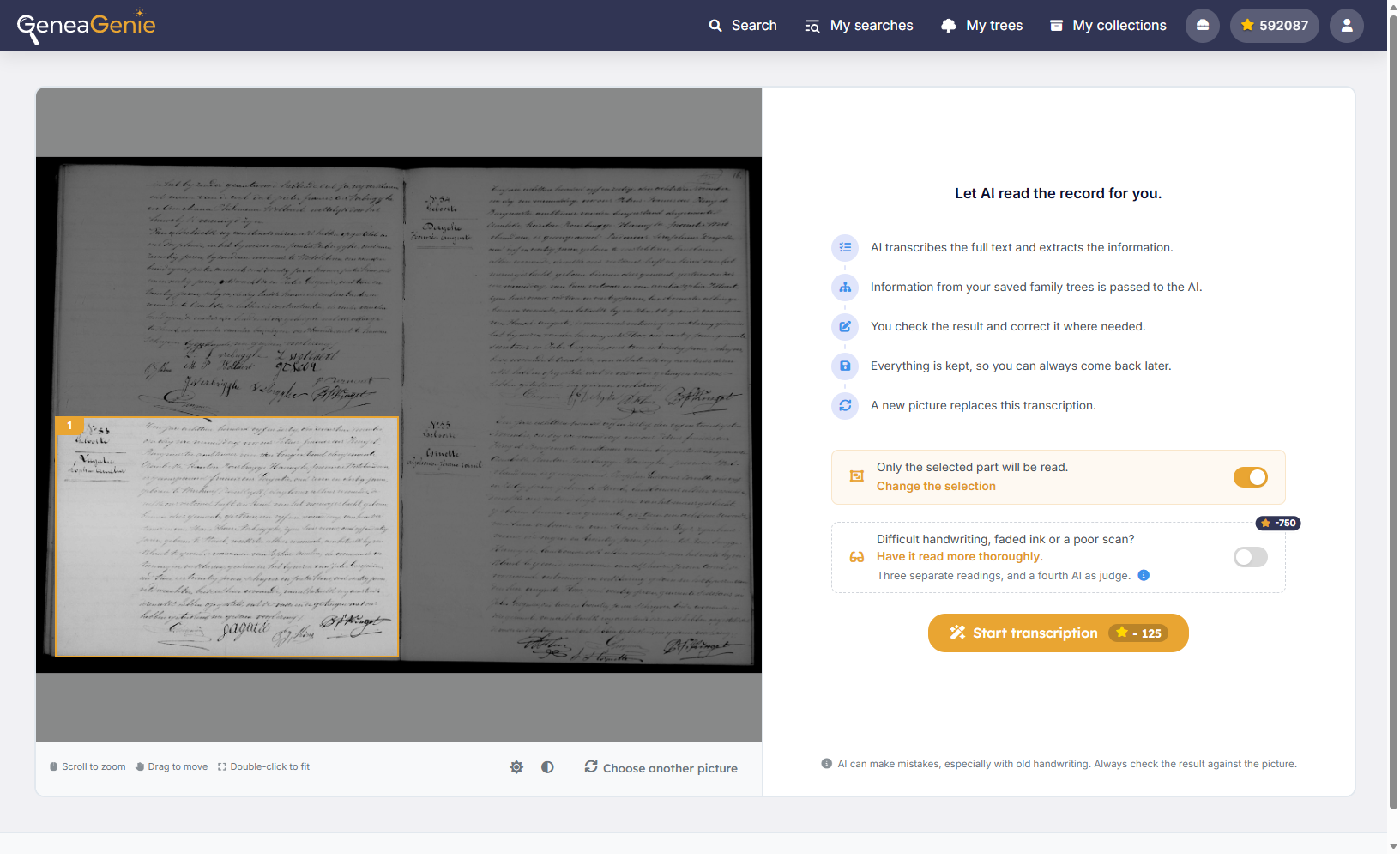
Upload or paste a scan and let GeneaGenie do the first reading. The AI first identifies the document type, approximate period, language, handwriting and dating system. It then transcribes the document line by line, extracts the people, dates, places and other details, and writes a short summary. You check everything beside the original image before saving it to your search.
Enable thorough reading for difficult handwriting. This option is especially useful for dense notarial deeds or seventeenth-century parish records, where faded ink, old abbreviations and an unfamiliar hand can make a single reading uncertain. Three AI readers independently transcribe the image. Their readings are aligned, and every disagreement is sent to a fourth AI for a second look at the image. If the readings still do not agree strongly enough, the alternatives remain visible in the transcription for you to decide.
AI can save a great deal of typing, but it can still misread old handwriting. The image always remains the authority, and every result stays editable.
Transcribing an original record with AI, reviewing it and adding it to a search.

Your next research step

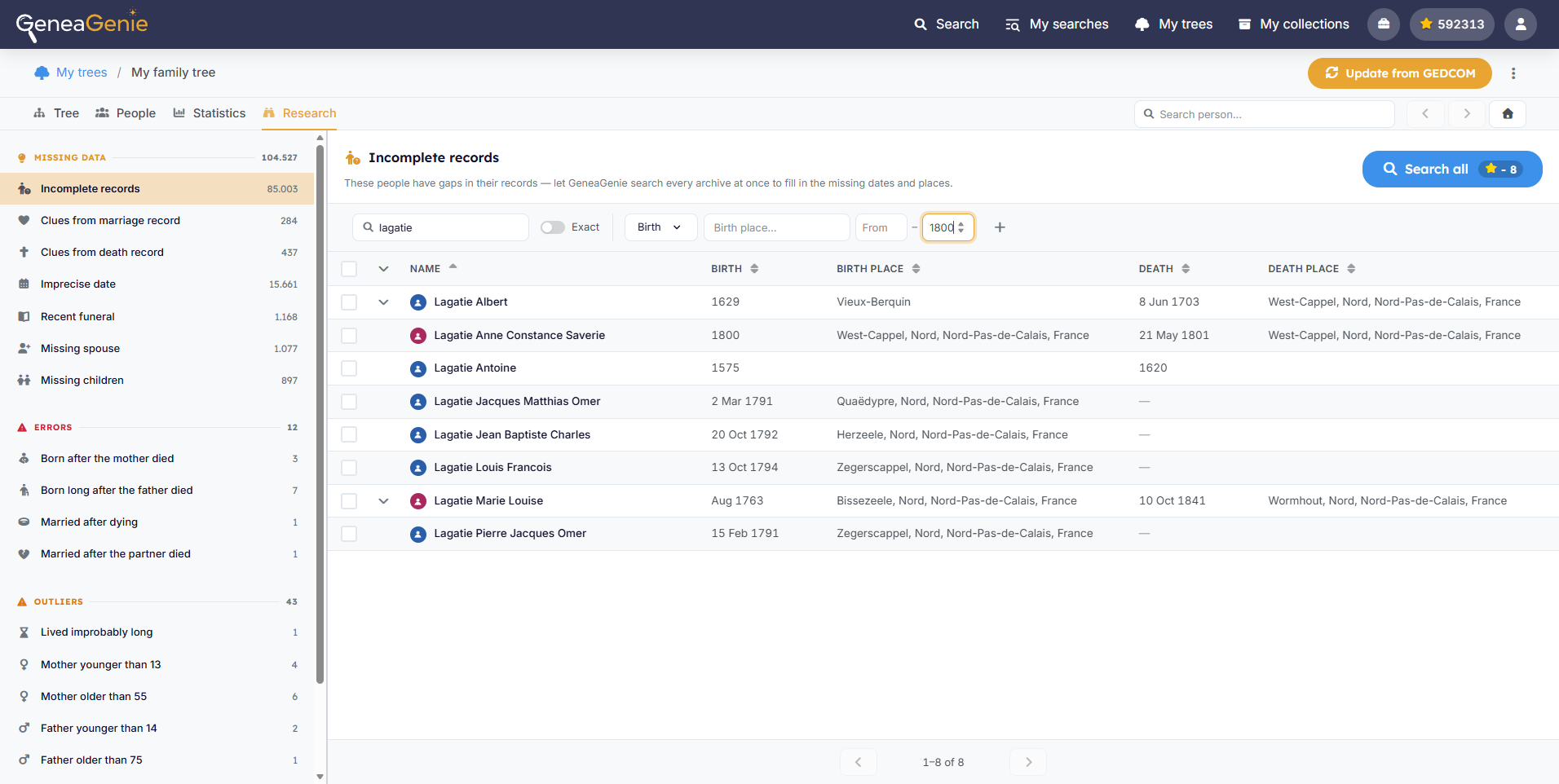
Research opportunities now have their own place in your family tree. There you will find missing events and details that may still be worth investigating, so you can focus on the people and questions that can move your research forward.
GeneaGenie now also checks your tree for contradictions and unlikely data: a death before a birth, a marriage after a death, implausible ages, children born too close together, unusually large age gaps and more. Each finding points back to the people and dates involved, so you can verify the source instead of guessing which value is wrong.
Research opportunities and checks for missing, contradictory or unlikely information in a family tree.

3 new sources in Belgium

Archiefbank Hageland – Civil registration – 19,028 records
A collaboration rooted in the city archives of Aarschot and Diest, Archiefbank Hageland brings together civil registration from the Hageland and the neighbouring Zuiderkempen. These birth, marriage and death records are a welcome new route into families from the towns and villages between Leuven, Aarschot and Diest.
Visit Archiefbank Hageland
Stadsarchief Kortrijk – Memorial cards – 204,648 records
For anyone with roots in Kortrijk and the Leie region, these memorial cards preserve the personal side of West Flemish family history: names, relatives and small details that official registers often leave out. Until now they existed only as scans and could not be searched by name. We used AI to index them, making more than 204,000 cards searchable for the first time.
Visit Stadsarchief Kortrijk
FelixArchief Antwerpen – Death notices – 10,965 records
The FelixArchief's collection of nineteenth- and twentieth-century family announcements brings the people of Antwerp's busy port city a little closer. Death notices often name spouses and relatives and preserve addresses or funeral details, making them a personal complement to the official civil registers.
Visit FelixArchief

3 new sources in the Netherlands

Zeeuws Archief – 2,010,300 records
The largest addition this month reaches across Zeeland: from Walcheren and the Bevelanden to Schouwen-Duiveland and Zeeuws-Vlaanderen. The latter began civil registration under French rule in 1796, years before most of the Netherlands followed in 1811. These records let you follow Zeeuwse families through generations of island villages, port towns and changing municipal borders.
Visit Zeeuws Archief
Gemeentearchief Venray – 129,317 records
RooyNet is the digital memory of Venray and the surrounding villages in North Limburg's Peel region. Its birth, marriage and death records stretch from the French period into the twentieth century, helping you connect generations and reconstruct families from Venray and its neighbouring villages.
Visit Gemeentearchief Venray
Gemeentearchief Tholen – 67,419 records
These records cover the closely connected communities of the former islands of Tholen and Sint Philipsland: from the small city of Tholen to Sint-Maartensdijk, Stavenisse, Oud-Vossemeer and the surrounding polder villages. A valuable source for tracing families who lived between Zeeland's water, dikes and reclaimed land.
Visit Gemeentearchief Tholen
Ready for year two?
Continue your research
If you have any feedback about GeneaGenie, we'd love to hear it!